




For beer lovers
Croats have always loved beer, but lately they can enjoy a truly wide range of different types and flavours because we are currently witnessing a real craft beer revolution in Croatia!

Photo credit: Radovan

Photo credit: Adam Wilson
Cover photo credit: Frank Luca
A new craft beer from local producers appears on the market every day, and indeed, we can say that beer in Croatia is going through a real Renaissance. Like wine, beer has its rules of tasting. From the choice of the glass to the density of the foam, read all the tricks on how to sip a beer like a true connoisseur.
Beer was always present on tables of cafés and restaurants, refreshing, delicious and a good accompaniment to a variety of dishes. In the last few years, we are witnessing a big hit in the beverage sector in Croatia - craft beer! Lager beers are probably the most popular and best selling beers in the world, made with bottom-fermenting yeast. Among craft beers, the most popular ones are the ale-type beers, which are, unlike a regular lager, more aromatic and of fuller taste, with more bitterness and alcohol. Ales are made from top-fermenting yeast. The most produced ales in Croatia are the aromatic APA (American Pale Ale) and IPA (India Pale Ale), as well as ABA (American Blonde Ale).
French beer sommelier and beer expert Cyril Hubert can recognize up to fifty different types of beer by tasting, and shared a few tips for drinking beer:
1. Air, heat and light are the three enemies of quality beers. When you buy beer at the store, always prefer to choose the one in the brown bottle, because the penetration of light is minimal. Clear or green bottles allow more light to penetrate. Under the influence of light beer can take on an unpleasant smell. When opening a bottle, you must hear the characteristic "tsssck" sound. If there is no such sound, be careful because the beer may be stale. The cans are a good alternative because they do not allow light to penetrate, they are also more resistant to shocks, and they take up less space.
2. Key factors when serving: tilt the glass as you pour because you'll get a good balance of foam and liquid. Before pouring, don't wipe the glass on the inside, because beer is sensitive to remains of grease and dust. Tulip-shaped or cup-shaped glasses will highlight different flavours in a beer. Beer that fermented at low temperatures has a smaller palette of flavours and can be served in elongated glasses.
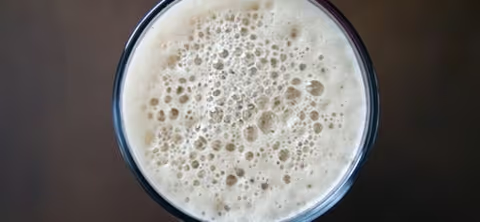
3. Foam, a guarantee of quality. When tasting, foam is the first factor that our specialist analyzes. It can be airy or strong, white or slightly coloured, rare or thick... it creates a boundary between air and liquid and provides longer-lasting aromas.
A lot of people are accustomed to drinking the transparent, shining beer. Therefore, when they see the murky liquid or sediment at the bottom of the bottle, they think that the beer is tainted, but that couldn't be farther from the truth! When it comes to craft beer, it is precisely the haziness that marks the quality and signalizes that the second fermentation occurred in the bottle. On the other hand, lager beer shouldn't be cloudy. If you're served a hazy lager, that means it wasn't filtered properly or that it was at the bottom of the barrel.



